
In essential oil and perfume packaging, unstable drop volume often leads to inconsistent dosage, formula deviation, and poor user experience for brands. This article explains how drop count is calculated, what factors affect it, and how packaging design ensures stable and reliable performance.
How Many Drops Are There in a Bottle of Essential Oil?
How Many Drops Are There in 1ml of Essential Oil?
1ml essential oil ≈ 20-25 drops. According to most usage conditions, the volume of each drop of essential oil is about 0.04-0.05ml to obtain this conversion range.
This value is not absolutely fixed, but rather an industry reference range. Mastering this basic data helps brands in formula development, filling calculations, and cost control.
Reference for Droplet Count in Essential Oil Bottles of Different Capacities
Estimate the number of drops based on the ratio (calculated as 1ml ≈ 20-25 drops):
| Essential Oil Bottle Size | Approximate Number of Drops | Recommended Applications |
| 5ml Essential Oil Bottle | 100–125 drops | Sample bottles, trial sizes |
| 10ml Essential Oil Bottle | 200–250 drops | Daily retail sales, essential oil collections |
| 15ml Essential Oil Bottle | 300–375 drops | Gift sets and promotional kits |
| 30ml Essential Oil Bottle | 600–750 drops | Medium-volume retail packaging |
| 50ml Essential Oil Bottle | 1,000–1,250 drops | Professional blending and formulation |
| 100ml Essential Oil Bottle | 2,000–2,500 drops | Bulk packaging and wholesale distribution |
Note: Even if the bottle capacity is the same, there may still be differences in the final drip count if you use different types of dropper designs.
What Factors Affect the Number of Essential Oil Drops?
The number of drops of essential oil is not fixed, and the actual number of drops per bottle may vary depending on the dropper design, essential oil characteristics, and usage environment.
The Influence of Dropper Structure on Droplet Count
If you want essential oil bottles to maintain a consistent user experience across different batches, the dropper structure is one of the packaging components that you need to focus on.
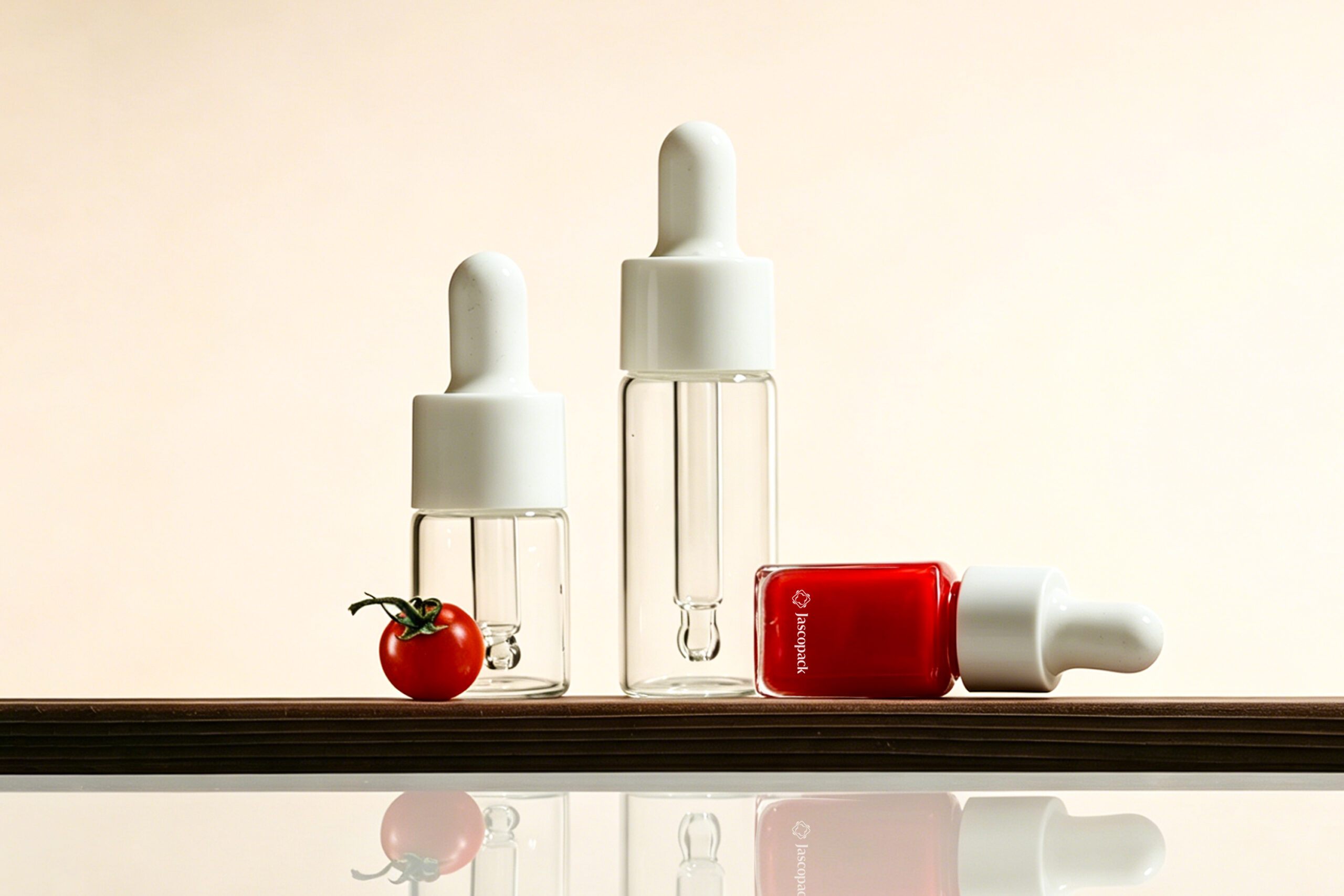
Glass dropper: suitable for high-end essential oils, high viscosity formulas, and aromatherapy products. In the production process, it can provide more stable droplet control and better chemical resistance.
Plastic dropper: It has a cost advantage and is widely used in large-scale production.
The air pressure at the dropper or bottle mouth and the size of the dropper aperture can also affect the droplet velocity and single droplet volume, leading to changes in the number of droplets.
Influence of Essential Oil Viscosity
Different essential oils have varying viscosities, which directly influence volume per drop, essential oil dosage, essential oil formulation accuracy, essential oil concentration, and overall dispensing performance.
High viscosity essential oils, such as heavy woody or vanilla essential oils, have low fluidity and form larger droplets, resulting in fewer droplets.
Low viscosity essential oils, such as citrus or floral essential oils, have fast fluidity, small single drop volume, and more drops.
Therefore, when developing different types of essential oil products, you need to consider the influence of formula viscosity on droplet count, match the appropriate dropper structure according to the viscosity of the essential oil, and try to maintain the stability of the liquid output between different products.
Environmental Factors
Generally speaking, under high temperature conditions, the viscosity of essential oils decreases, their fluidity increases, and the formation rate of each droplet accelerates, resulting in an increase in the number of droplets. On the contrary, in low-temperature environments, the number of droplets will decrease.
If your product needs to be exported to high-temperature markets such as the Middle East and Southeast Asia, the packaging must be tested under different temperature conditions to ensure stable performance.
Why Is Droplet Consistency Consistency Important for Brand Experience?
After you have understood the droplet range of different capacity essential oil bottles and the key factors that affect droplet variation, the more important question is whether these “droplet differences” will affect customers’ perception and evaluation of your brand.
Affects Brand Professionalism Perception
If there is a significant “difference in usage” of the same product at different stages of use, customers may subconsciously believe that the product is not professional or stable enough. Even if the formula is consistent, it will gradually affect customers’ judgment of the overall product quality and subconsciously reduce the brand’s professional credibility.
Impact User Trust and Long-Term Repeat Purchases
When the drop count remains stable, users will gradually form clear usage habits and expectations, such as the approximate amount of each use and the time a bottle of product can be used. This stable and predictable user experience will enhance users’ trust in the brand and increase their willingness to repurchase.
Based on the above influencing factors, it can be seen that the instability of droplet count is not a single-link problem, but a systematic result that runs through the design of dropper structure, material selection, and production process. Therefore, to truly improve product consistency, it is not enough to rely solely on user experience. Source control is also required from the packaging manufacturing stage.
How to Ensure the Stability of Essential Oil Droppers During Production?
When you purchase essential oil packaging, what really affects product quality is often not the appearance of the bottle, but the consistency of the liquid output that users cannot see. If the drop in volume of different batches of products fluctuates too much, it will directly increase the cost of quality complaints and after-sales communication.
Therefore, professional packaging manufacturers usually start from multiple aspects, such as structural design, simulation testing, quality assurance, production consistency, and quality control, to help you improve product consistency and reliability.
High Precision Mold Design
The aperture size of the dropper directly affects the liquid output and filling accuracy. Even if the size deviation is very small, it may lead to changes in droplet volume during long-term use.
By strictly controlling the tolerance of the opening size of the dropper, ensuring consistent liquid output from each dropper, and stable single droplet volume, we help your product maintain stable performance in long-term use, thereby enhancing brand professionalism awareness.
Standardized Droplet Testing
Through standardized experimental methods, you can measure and confirm the actual liquid output performance of each type of dropper structure before mass production, such as whether the single droplet volume is stable and whether the droplet velocity is consistent.
Based on the test results, you can further optimize the matching relationship between the dropper and bottle mouth design to ensure that the droplet count remains within a controllable range during mass production.
Material Matching Test
The viscosity difference of essential oils themselves will directly affect the discharge state of the dropper. Therefore, in the structural design phase, it is necessary to focus on the matching relationship between the formula and materials, and select the appropriate dropper material and structure based on the viscosity of the essential oil.
High viscosity essential oils can be paired with glass droppers, while low viscosity essential oils can use plastic droppers. Through this matching optimization, you can effectively reduce the instability of droplet volume caused by formulation issues.
Batch Quality Control
Before mass production, key indicators such as droplet consistency and sealing performance of essential oil bottles can be confirmed in advance through sampling testing and pressure testing. By combining transportation simulation and testing under different environmental conditions, the risk of quality differences between different batches of products can be further reduced.
These tests can help you detect potential drop volume fluctuations in advance, thereby avoiding complaints and rework costs caused by batch differences in the later stage, making the final delivered essential oil bottle products more stable and reliable.
Conclusion
Stable drop performance is not only about formulation, but also depends on precise dropper design and packaging engineering. Jascopack provides customized essential oil and cosmetic packaging solutions to help brands improve consistency, reduce risk, and support scalable production for global markets.
FAQ
Which packaging structure is more suitable for high viscosity essential oils?
The high viscosity essential oil here generally refers to essential oils with high resin content, wooden substrate, or concentrated blending type. Its characteristics are low fluidity, high internal friction, and it is more prone to phenomena such as “slow flow, obvious wall hanging, and uneven liquid discharge” at room temperature.
For this high viscosity essential oil, it is usually recommended to use a packaging structure that combines a glass dropper with a precision dropper. The inner wall of the glass dropper is smoother, the liquid output is more stable, and it is easier to control the amount dropped each time.
By matching the appropriate dropper material and bottle mouth structure, you can effectively reduce issues such as leakage and unstable drip volume, and improve product consistency in mass production for essential oil bottle packaging and dropper bottle systems.
Why is the stability of drops important for essential oils and perfume products?
For essential oil and perfume products, it is very important to rely on accurate formula proportions to ensure the aroma level and use effect, especially in essential oil dropper bottle packaging and perfume bottle applications.
If the drip volume is unstable, even with the same formula and ingredients, there may be differences in the actual amount of liquid used each time, which can affect the concentration and level of aroma, and lead to inconsistent essential oil dosage per drop and dropper bottle performance.
For you, this not only concerns whether the performance of the essential oil bottle is stable, but also affects consumers’ perception of brand quality in the cosmetics packaging and aromatherapy packaging industry. Especially in the high-end essential oil, aromatherapy products, and perfume markets, users always expect a consistent experience every time they use essential oil dropper bottles.
Why do different batches of essential oil bottles have different drop counts?
Even with the same formula, there may still be differences in droplet count within a certain range between different batches of products. Common causes of these problems:
The tolerance of the opening size of the dropper is unstable.
Insufficient precision of the dropper or bottle mouth mold;
There are fluctuations in the filling and assembly processes.
The compatibility between the product formula and the dropper structure is different. Changes in environmental temperature and air pressure.
Therefore, for brands, it is more important to control droplet consistency and batch stability in essential oil packaging manufacturing, rather than pursuing a completely fixed droplet count.